Programmatic Advertising in EVADAV Ad Network: Our Approach and Advantages
In our EVADAV Ad Network overview, we introduced our platform to advertisers and publishers who manually manage traffic and advertising. However, there is an alternative approach that differs in terms of ad sale method and scaling– programmatic advertising.
Today, we'll dive deeper into this technology: how programmatic advertising works, the specifics of launching ad campaigns and monetizing traffic, and the advantages of partnering with our platform.
What Is Programmatic Advertising
Programmatic advertising is the automated buying and selling of digital ad space using technology and machine learning algorithms. Unlike traditional advertising, which requires manual configuration, programmatic advertising allows automated systems to match publishers and advertisers and adjust bids and campaign settings based on real-time user data.
How Programmatic Advertising Works
-
An advertiser sets campaign parameters through a DSP (Demand-Side Platform): target audience, budget, geography, and ad formats.
-
A website owner (publisher) who wants to earn from advertising connects their site to an SSP (Supply-Side Platform).
-
When a user visits the site, the system detects that an ad placement slot is available on the page.
-
That slot is immediately sent to auction. Advertisers whose targeting matches this user can compete for the impression. The ad exchange sends bid requests to all connected DSPs.
-
Each advertiser has certain bid limits that are matched with the ad exchange bid floor.
-
The winner is the advertiser with the most competitive bid. Their ad is then shown to the user.
-
The entire process happens automatically and almost instantaneously. The user simply opens a page and sees an ad, while a complete mini-auction has already taken place in the background.
Key Elements of Programmatic Advertising
The programmatic ecosystem is built on several, each playing a distinct role:
|
Element |
Description and Role |
|
DSP (Demand-Side Platform) |
The demand-side platform. Used by advertisers and agencies to automatically purchase ad inventory through SSPs, ad exchanges, and direct integrations. The DSP determines which impressions to buy and at what price, using targeting data, budget parameters, and campaign goals. |
|
SSP (Supply-Side Platform) |
The supply-side platform. Used by publishers (website and app owners) to manage and sell ad inventory. The SSP connects a publisher to multiple ad exchanges and DSPs simultaneously, enabling them to achieve maximum CPM for each impression. |
|
Ad Exchange |
A digital marketplace where ad inventory is automatically bought and sold through RTB (real-time bidding) auctions. Advertisers enter via DSPs, publishers via SSPs. The ad exchange analyzes targeting criteria, budgets, and placement parameters to determine the auction winner. |
|
DMP (Data Management Platform) |
A data management platform. Collects and processes first- and third-party data from multiple sources (site visits, CRM, third-party providers). Builds detailed user profiles to enable more precise targeting. |
|
Ad Network |
An intermediary between advertisers and publishers. Aggregates ad inventory from many publishers and matches it to advertiser demand. Simplifies the placement process but typically offers less transparency and control than direct buying through a DSP. |
EVADAV Ad Network possesses a full stack of programmatic advertising technologies: DSP, SSP, and ad exchange, all operating on a single unified platform.
The key competitive feature of EVADAV’s programmatic advertising is direct integrations. The DSP is connected directly to publishers, and the SSP is connected directly to advertisers. This eliminates intermediary reselling and increases transparency for both sides.
KPI Metrics to Track
After launching a campaign, it's essential to monitor the right performance metrics:
-
QPS (Queries Per Second) is a metric that measures how many bid requests an SSP sends to a DSP every second, essentially reflecting the volume and speed of auction traffic flowing through the programmatic pipeline. For DSPs and ad networks, managing QPS is critical – too high and infrastructure gets overloaded, too low and you miss auction opportunities, so buyers often negotiate QPS limits with supply partners to balance reach against server costs.
-
Impressions measure the total number of times an ad was displayed within a campaign. One impression is counted each time a creative loads on a webpage, in an app, or on a screen and is shown to a user.
-
Clicks indicate how many times users interacted with your ad by clicking on it. This metric helps assess how effectively your target audience engages with the ad.
-
Click-through rate (CTR) is the percentage of users who clicked on your ad after seeing it. It is calculated as the number of clicks divided by the number of impressions, multiplied by 100. The higher the CTR, the more effectively the ad engages its target audience.
-
Conversions occur when a user completes a target action you are tracking (such as making a purchase, booking a demo, or subscribing to a newsletter) after interacting with the ad. This helps measure campaign success.
-
Cost per acquisition (CPA) shows how much it costs to achieve a specific campaign goal, such as a sale, lead, or app install. Total campaign spend is divided by the number of conversions to calculate CPA and evaluate the efficiency and profitability of programmatic advertising campaigns.
-
Cost per completed view (CPCV) measures the cost of having a user watch your video or CTV ad through to completion. It is calculated as total campaign spend divided by the number of completed views.
Different metrics could be relevant depending on the campaign objectives:
|
Campaign Goal |
Key Metrics (KPIs) |
|
Branding and Awareness |
Reach / Unique Reach, Average Frequency, Share of Voice, Brand Lift, Views |
|
Interest and Consideration |
Video Completion Rate, Clicks, Site Visits, Engagement, Leads, CPA |
|
Purchase / Conversion |
ROAS, ROI, Sales, Subscriptions, ACOS, CPA |
|
Video and CTV |
CPCV (cost per completed view), VTR (view-through rate), CTR |
The baseline metrics for monitoring any campaign are impressions, clicks, CTR, conversions, and CPA (cost per acquisition).
EVADAV Ad Network partners gain access to customizable analytics: all standard performance metrics are displayed, and additional parameters can be added as needed for a specific client's objectives. The platform identifies which traffic sources convert best for a given partner and uses that data to fuel mutual growth.
EVADAV has accumulated a significant data asset over the years in the market, enabling the team to track product and vertical life cycles and forecast them based on real system requests and responses.
Types of Programmatic Deals
Source: https://www.linkedin.com/pulse/4-types-deals-programmatic-advertising-somya-goswami-a28ec/
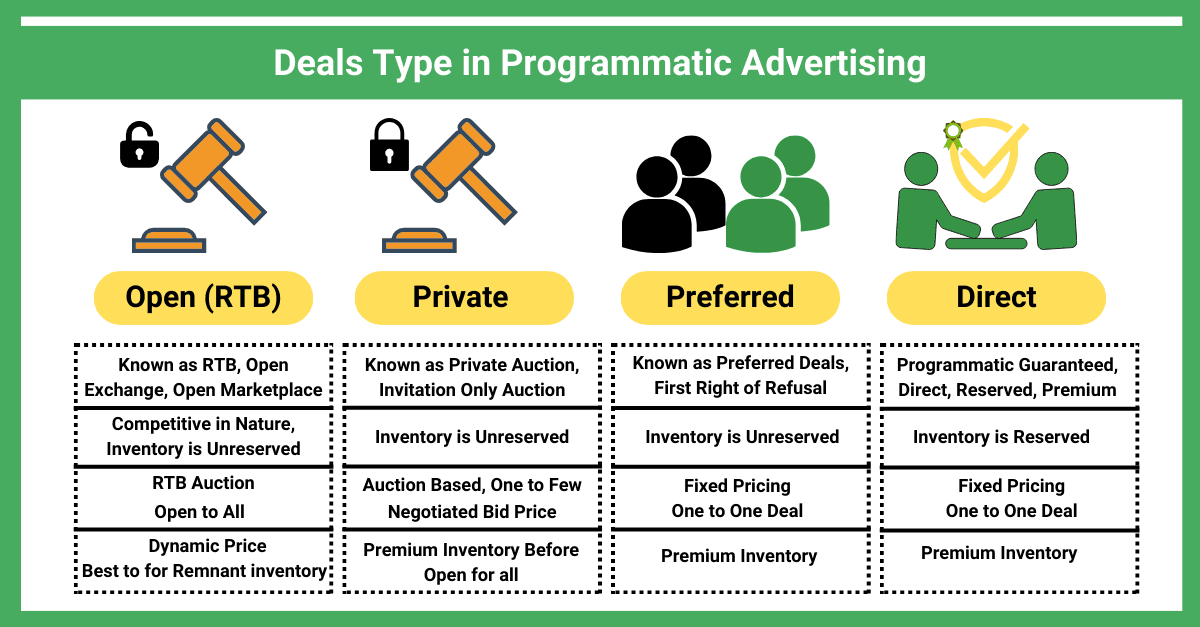
There are four primary methods for purchasing inventory in programmatic advertising, each with its own specifics:
-
Real-Time Bidding (RTB) / Open Auction. The most common method. This is an open, real-time auction where an unlimited number of advertisers compete simultaneously. The winner is the one who submits the highest bid. Open auctions provide access to a wide range of inventory, often at lower prices than other deal types.
-
Private Marketplace (PMP). An invitation-only closed auction with a limited number of participating advertisers. Inventory available through a private marketplace is generally considered more exclusive and higher-quality than that on the open market.
-
Preferred Deals. An advertiser negotiates a fixed price with a publisher for specific inventory, but is not obligated to purchase it. If the advertiser passes, the inventory moves to the open auction or PMP. This is a hybrid format between programmatic guaranteed and auction-based buying.
-
Programmatic Guaranteed (Direct). A direct agreement between an advertiser and a publisher at a fixed price with a guaranteed number of impressions. This is ideal for campaigns where predictable placements and access to premium inventory are critical. There is no bidding: everything is agreed upon in advance.
EVADAV operates primarily with the RTB model of programmatic advertising. At the same time, we support all essential standards and connection types, including OpenRTB and XML integrations. Technical flexibility is ensured by an in-house development team: unlike companies operating on third-party white-label solutions, EVADAV can rapidly adapt its system to market demands or the specific requirements of any partner.
Advantages of Programmatic Advertising
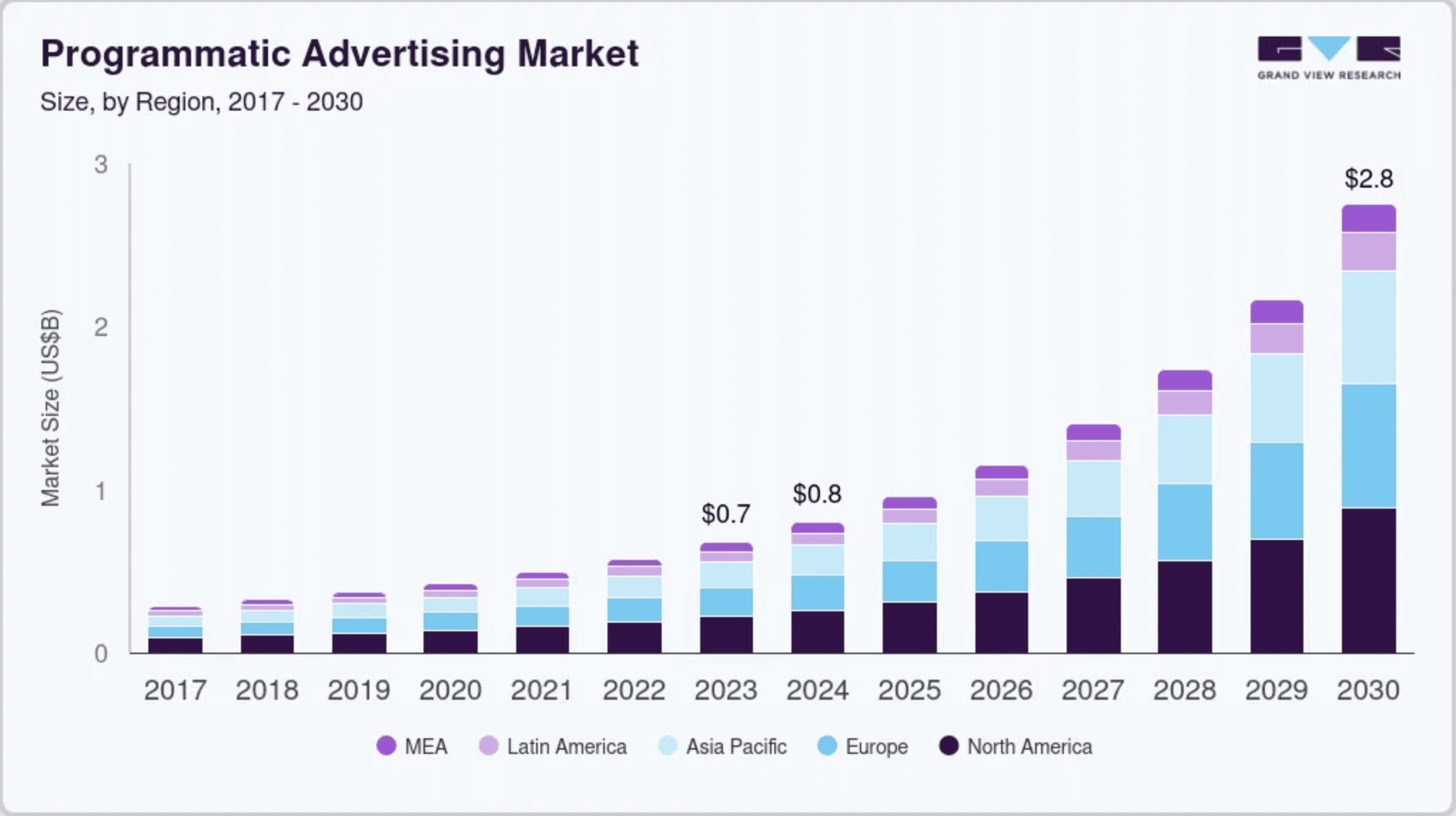
According to Emarketer, by 2026, 96% of all display advertising will be transacted programmatically. Statista projects global spending on it to reach nearly $800 billion by 2028.
Source: https://www.grandviewresearch.com/industry-analysis/programmatic-advertising-market-report
So, why do advertisers and publishers work with programmatic advertising?
Benefits for Advertisers
-
Maximum efficiency. Setting up individual campaigns on each platform (Google, Meta, TikTok, Spotify, and others) requires an enormous amount of time. Programmatic advertising automates ad buying across all channels and formats from a single platform, freeing up time for other important tasks.
-
Broad reach. Programmatic advertising provides access to thousands of websites, apps, and streaming services, from globally recognized platforms to regional media outlets worldwide.
-
Precise targeting. According to ParcelLab research, 49% of users encounter irrelevant ads, and 42% of them immediately unfollow the brand. Programmatic advertising helps avoid this: targeting can be configured by demographics, interests, behavior, purchase patterns, and even the topics of content being read, following users throughout their purchase journey across multiple devices.
-
Flexibility and control. Unlike traditional advertising, most programmatic campaigns are not locked into rigid constraints. Targeting parameters can be adjusted, creatives swapped, and campaigns scaled in real time without prior negotiations or long-term contracts.
-
Transparency. Advertisers can see exactly where their ads are being placed, how much is being spent, and who is seeing them. This enables confident brand safety management and data-driven campaign optimization.
-
Real-time measurability. Detailed analytics are available instantly — no need to wait days or weeks. Performance metrics allow changes to be made even during an active campaign.
Benefits for Publishers
-
Revenue improvement. Programmatic advertising triggers a real-time auction among multiple advertisers simultaneously, which drives up the CPM compared to direct sales or fixed rates. Publishers receive the market rate for each impression rather than a pre-negotiated price.
-
Access to a larger advertiser pool. Instead of manually searching for and negotiating deals individually, a publisher connects to a multitude of advertisers through an SSP at once, gaining demand across the entire market.
-
Inventory fill rate. Programmatic advertising helps monetize even remnant or hard-to-sell inventory (low-traffic pages, non-standard placements) that would be difficult to sell directly.
-
Time and resource savings. No large sales team is needed to negotiate with each advertiser individually because auctions and deals are handled automatically.
-
Control over ad quality. Publishers can set restrictions: which ad categories to display, which to block (such as competitors or undesirable topics), and establish floor prices (minimum CPM per impression).
-
Variety of monetization formats. The same inventory can be monetized through different formats (popunder, in-page, push, native, etc.), increasing flexibility and potential revenue from the same audience.
-
Transparent reporting. Publishers have access to real-time data: inventory buyers, bids, and performance metrics. It helps optimize placements and increase revenue.
Formats of Programmatic Advertising
Programmatic advertising allows placement on virtually any digital channel – on smartphones, desktops, and other internet-connected devices.
EVADAV Ad Network works primarily with four proven formats:
Popunder

Popunder is an ad format in which an ad page opens in a new browser tab or window behind the user's current page. The ad remains hidden until the user closes or minimizes the active window. The format does not interrupt content browsing while guaranteeing 100% viewability — the ad message cannot be missed or accidentally closed. Popunder is especially effective for high-conversion-value offers: iGaming, Finance, Health, and VOD services.
In-Page
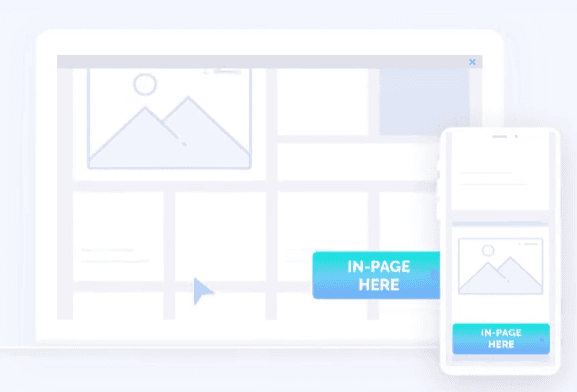
In-page is a banner format that visually mimics system push notifications but appears directly within the web page itself. Unlike classic push notifications, it does not require user subscription and works on all devices and browsers. The ad consists of an icon, headline, and brief text, blending organically into the page's interface without feeling intrusive. The format delivers a high CTR with minimal negative user experience.
Push

Push notifications are delivered directly to the device of a user who has opted in to receive them. The ad appears outside the browser (on the lock screen or in the notification panel) and remains visible until the user opens or dismisses it. The key advantage of this format is engagement with a warm audience: the user has already shown interest by voluntarily subscribing to notifications. This results in high engagement rates and a consistently strong conversion rate (CR).
Native

Unlike banners, native ads blend organically into the platform's surrounding content, whether a social media feed or a news site's homepage. They are styled as recommended or sponsored content, making them less intrusive and increasing both engagement and CTR. This approach reduces banner blindness, builds trust in the message, and increases the likelihood of a click. The native format works well in such verticals as News & Content, E-commerce, and Health.
In addition to the formats mentioned above, EVADAV is actively developing banner, video, and CTV advertising. The vertical selection strategy is built around three parameters: GEO, ad format, and vertical. Years of experience allow us to define optimal combinations, for example, CTV for News & Content, banner and video for iGaming, and in-app for Asian markets.
Read More: A Detailed Overview of EVADAV’s Ad Formats for Publishers
Potential Challenges and How EVADAV Ad Network Addresses Them
Entry Threshold
Despite a high level of automation, programmatic advertising still requires a learning curve: configuring a DSP, understanding auction mechanics, working with data – all of this can seem overwhelming at first. It goes without saying that some ad networks might have pretty high entry thresholds:
Unlike traditional ad networks, programmatic advertising has no formal minimum requirements for budget or traffic volume. At EVADAV, we assess compatibility with partners in terms of geo/format/vertical through entry questionnaires.
Ad Fraud
EVADAV employs both proprietary anti-ad fraud tools and standard market instruments, depending on partner requirements. Before onboarding, every partner undergoes a verification process to ensure compliance with the platform's internal standards and the other party's expectations. The team reviews inbound and outbound traffic and applies filtering tags. Traffic quality control is one of the platform's key operational priorities at the current stage.
Competitive Environment
All advertisers compete on the same platforms, and certain types of inventory may be in short supply. At EVADAV, the solution lies in using programmatic guaranteed deals, which unlock access to premium inventory.
Data Privacy
Many advertisers and publishers are concerned about how their personal data is used. At EVADAV, all partner data is stored within the platform and is never shared with third parties. The system uses internal identifiers that are unrelated to names or company titles. EVADAV operates on the firm principle of non-disclosure – a core part of the company's culture.
Why Choose Programmatic Advertising with EVADAV Ad Network
EVADAV partners don’t just use top-notch technologies – they access a fully realized programmatic advertising ecosystem built around transparency, flexibility, and quality:
-
Complete infrastructure on a single platform. DSP and SSP are directly connected to the ad exchange and operate within a unified environment – no need to assemble a stack from multiple providers.
-
In-house tools. Unlike platforms built on white-label solutions, EVADAV can rapidly adapt its system to meet market demands or the specific needs of the partner. We can discuss it individually and, when financially feasible, implement updates in analytics and other tools.
-
Traffic quality control. We develop advanced anti-ad fraud tools to exclude bot traffic and offer individualized filtering configurations for each partner.
-
Low entry threshold. No rigid minimums on budget or traffic volume – the focus is on alignment by geo, format, and vertical.
-
Privacy and data protection. Our system uses internal identifiers instead of real partner names, so data is never shared with third parties.
-
Sustainable partnership model. EVADAV uses a diversified partner pool rather than relying on the largest market players, reducing risk and ensuring stable growth.
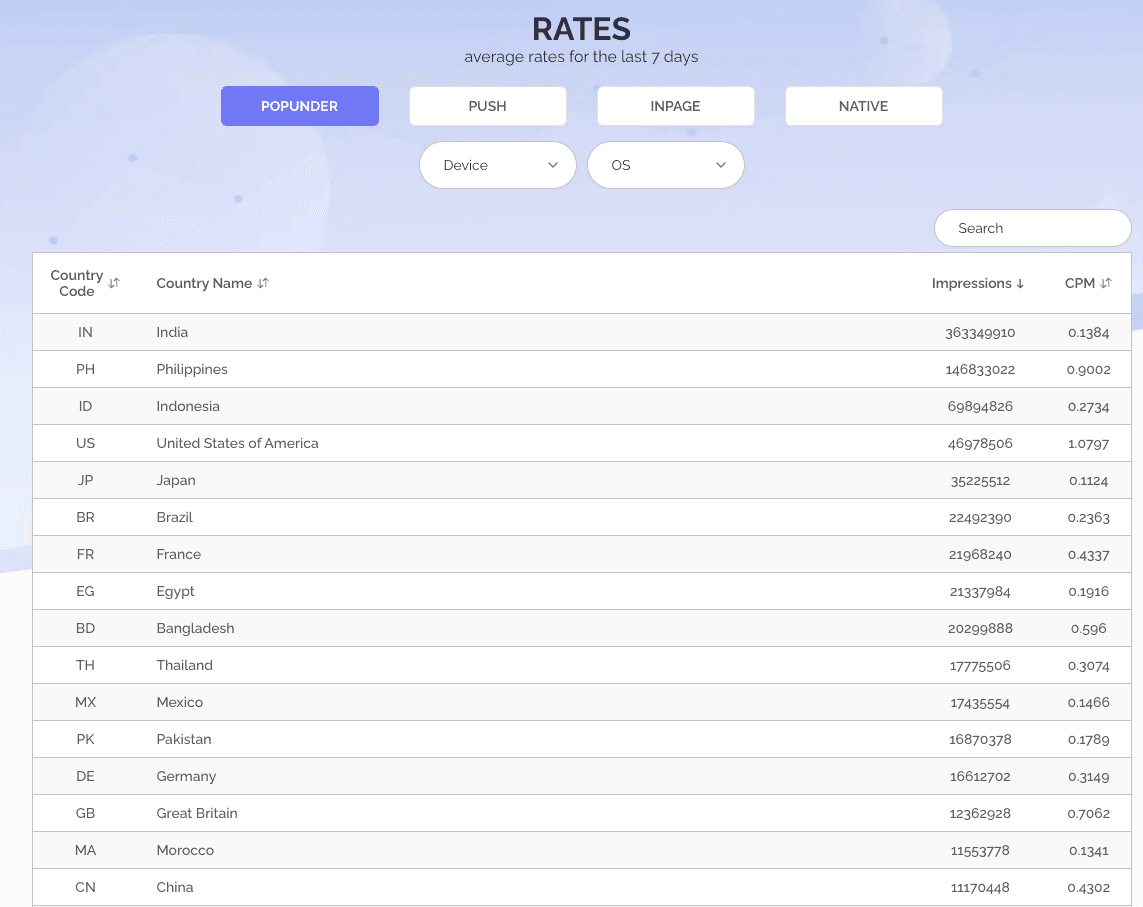
Besides, we provide real-time statistics (for example, average ad format rates) and market insights for our partners to make efficient decisions:
Wonder how programmatic advertising can improve your efficiency and profits? Submit your request here, and we'll help you with onboarding, whether you're an advertiser looking to scale traffic acquisition or a publisher aiming to extract maximum value from your project.